Landing your dream job often feels like navigating a digital minefield. You've got the skills, the experience, and the drive, but your meticulously crafted resume keeps disappearing into the void. The culprit? Often, it's the Applicant Tracking System (ATS), a software gatekeeper designed to filter out unqualified candidates before a human even sees them. Many status-quo resume tools, from basic word processors to static template builders, simply aren't equipped to tackle this algorithmic challenge. They leave the heavy lifting of keyword optimization and structural compliance entirely to the job seeker. This manual approach is not only time-consuming but frequently ineffective, leading to frustration and missed opportunities.
This is where specialized tools like the AI Resume Builder step in, promising a new paradigm. It aims to automate the tedious aspects of resume creation while actively optimizing for ATS compatibility.
Table of Contents
What is AI Resume Builder?
Key Capabilities & Real-World Implementation
AI Co-pilot for Content Drafting and Tailoring
Dynamic Templates with Drag-and-Drop Sections
Live ATS Score Checker for Optimization
Technical Comparison & Alternative Approaches
Pros and Cons Analysis
Final Verdict & Who Should Use It
What is AI Resume Builder?
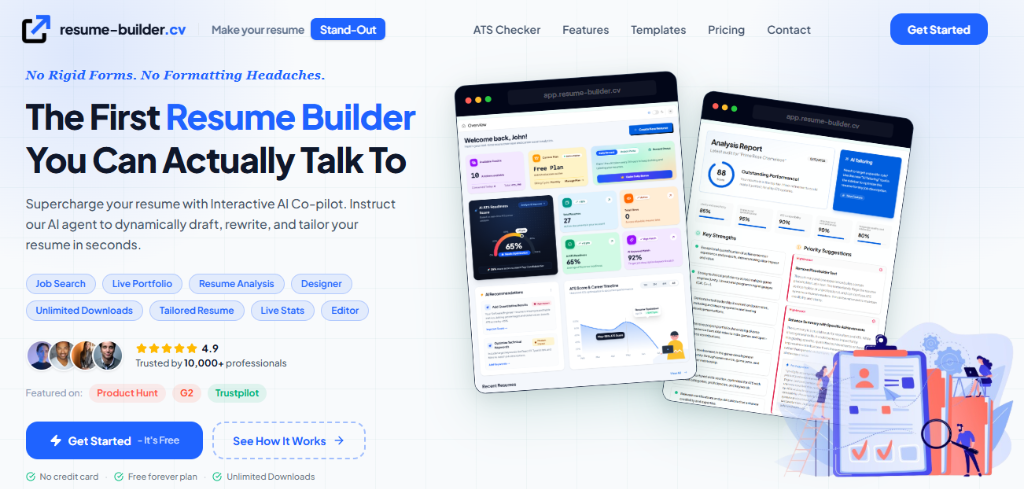
The AI Resume Builder is a SaaS application designed to streamline the resume creation process using artificial intelligence. Its core proposition is to transform a candidate's raw experience into an ATS-optimized document instantly. Unlike traditional builders that are primarily formatting tools, this platform integrates an intelligent AI co-pilot. This AI actively assists in drafting, rewriting, and tailoring resume content to specific job descriptions.
At its architectural heart, the system likely leverages advanced Natural Language Processing (NLP) models. These models are fine-tuned on vast datasets of successful resumes and job descriptions. When a user inputs their professional background and a target job description, the AI analyzes keywords, phrases, and semantic relationships. It then generates or suggests content that aligns with both the user's profile and the job's requirements. The workflow is iterative: input data, receive AI suggestions, refine, and then check against a live ATS score. This feedback loop is crucial for optimizing the document effectively. The platform abstracts away the complexities of content optimization, allowing job seekers to focus on showcasing their value rather than grappling with formatting or keyword strategies.
Key Capabilities & Real-World Implementation
The AI Resume Builder differentiates itself through a suite of features engineered for efficiency and effectiveness. Each capability addresses a specific pain point in the traditional job application process.
AI Co-pilot for Content Drafting and Tailoring
The AI co-pilot is the central intelligence of the platform. It functions as an interactive writing assistant. When a user provides their experience and pastes a job description, the AI analyzes it. It identifies key responsibilities, required skills, and industry-specific terminology. Based on this analysis, the co-pilot suggests bullet points, rewrites existing ones for greater impact, and ensures relevant keywords are naturally integrated. This feature drastically reduces the time spent on manual phrasing and customization. For instance, if a job description emphasizes "scalable cloud solutions," the AI might rephrase a user's bullet point from "Managed AWS infrastructure" to "Architected and managed scalable cloud solutions on AWS, ensuring 99.9% uptime." This intelligent tailoring helps align the resume's language directly with the target role's expectations, a critical factor for ATS systems.
Dynamic Templates with Drag-and-Drop Sections
While AI handles content, dynamic templates ensure professional presentation. The builder offers a range of visually appealing and industry-standard templates. These are not static documents but rather modular components. Users can drag and drop sections like "Work Experience," "Skills," "Education," or "Projects" to customize the layout. This flexibility allows for personalized structuring without sacrificing design consistency. Technically, these templates are likely rendered dynamically on the server or client-side, using well-defined JSON or XML schemas to separate content from presentation logic. This approach ensures responsiveness across various viewing platforms (desktop, mobile, recruiter portals) and prevents common formatting errors that plague static document editors. The underlying architecture ensures that regardless of layout choices, the output remains cleanly parsed by ATS.
Live ATS Score Checker for Optimization
Perhaps the most impactful feature, the live ATS score checker provides real-time feedback on a resume's compatibility. As users edit their content, the system continuously scans and evaluates the document against typical ATS algorithms. It assesses keyword density, section headers, readability, and overall structure. The score indicates the resume's likelihood of passing an initial ATS scan. For example, if an applicant tracking system expects specific headings like "Professional Experience" instead of "My Career Journey," the checker flags this. It also highlights missing keywords from the job description or formatting issues that could hinder parsing. This instant validation loop empowers users to iterate and refine their resumes. It moves beyond guesswork, providing objective metrics. Understanding how ATS systems parse information is key; tools often refer to parsing standards, such as those discussed in documents pertaining to HR-XML Consortium standards, though proprietary systems vary.
Technical Comparison & Alternative Approaches
Comparing the AI Resume Builder to existing solutions reveals its unique value proposition.
Traditional Word Processors (Microsoft Word, Google Docs): These offer maximum control over formatting. However, they lack any built-in ATS optimization. Users must manually research keywords, ensure parseable layouts, and constantly guess what an ATS "wants." They are inefficient for high-volume job applications.
Static Online Resume Builders: Platforms like Canva or standard template sites provide better aesthetics and fixed structures. They simplify design but still require manual content optimization. They typically offer no AI assistance or live ATS scoring, leaving users in the dark about their resume's machine-readability.
Manual Open-Source Solutions (e.g., LaTeX): For developers and highly technical users, LaTeX offers unparalleled customization and typesetting control. Projects like Awesome CV on GitHub allow intricate design. However, LaTeX has a steep learning curve, requires compilation, and crucially, provides no automated ATS feedback. It's a powerful tool for presentation but not for algorithmic optimization.
The AI Resume Builder bridges the gap, combining the ease of online builders with intelligent, data-driven optimization. It shifts the burden of ATS compliance from the user to the automated system.
"Integrating automated content generation with real-time feedback loops is critical for any scalable system. For job seekers, this translates to predictable resume performance. The AI Resume Builder's rapid iteration cycles and objective scoring mean candidates spend less time formatting and more time refining impact, directly translating to higher quality applications."
Pros and Cons Analysis
Every tool has its strengths and weaknesses. Understanding these helps users make an informed decision.
Pros:
Significant Time Savings: Automates content drafting, tailoring, and formatting, dramatically cutting down the resume creation time.
ATS Optimization: The live score checker and AI co-pilot directly address the challenge of passing applicant tracking systems. This increases visibility to human recruiters.
Professional Design: Dynamic templates ensure a polished, modern, and readable resume appearance without design expertise.
Ease of Use: Intuitive interface makes the tool accessible to users of all technical skill levels.
Targeted Content: AI tailors content to specific job descriptions, making applications more relevant and impactful.
Cons:
Potential for Generic Output: If users rely too heavily on AI suggestions without critical review, resumes might sound generic or lack a unique personal voice. Human oversight is still necessary.
Subscription Model: As a SaaS product, it requires a recurring subscription, which might be a barrier for some job seekers.
AI Accuracy Reliance: The effectiveness of the tool hinges on the underlying AI's accuracy and understanding of diverse industries and roles. Edge cases might exist.
Limited Extreme Customization: While templates are dynamic, those seeking highly unconventional or extremely visual portfolio-style resumes might find limits compared to manual design tools.
Final Verdict & Who Should Use It
The AI Resume Builder is a powerful tool for the modern job seeker. It effectively tackles the dual challenge of creating visually appealing resumes and ensuring they pass initial ATS screenings. Its intelligent AI co-pilot and live feedback system represent a significant leap forward from traditional methods. This tool empowers users to optimize their applications proactively, rather than reactively guessing what works.
This platform is highly recommended for:
Busy Professionals: Those with limited time to manually optimize each application.
Entry to Mid-Level Job Seekers: Individuals who need a clear, professional, and ATS-friendly resume to kickstart their careers.
Anyone Struggling with ATS: If your applications frequently get no response, this tool provides the direct feedback needed to improve.
Job Seekers Targeting Specific Roles: The AI tailoring feature is incredibly valuable for customizing resumes to multiple distinct job descriptions efficiently.
The AI Resume Builder isn't just about building a resume; it's about building an effective resume. It shifts the focus from manual labor to strategic optimization. It's an essential addition to any serious job search toolkit, streamlining the application process and boosting your chances of getting noticed. Learn more about the AI Resume Builder on SaaSearch.
Ready to optimize your job application strategy?
Try AI Resume Builder on their official website
Author: Billal