
Table of Contents
- Executive Overview & Direct Answer
- The Cognitive Burden of 200 Keyboard Shortcuts
- Context-Aware Window Sensing in macOS
- Firmware Architecture & Mechanical Construction
- Workflow Velocity & Usability Benchmarks
- Conclusion & The Future of Tactile AI
Executive Overview & Direct Answer
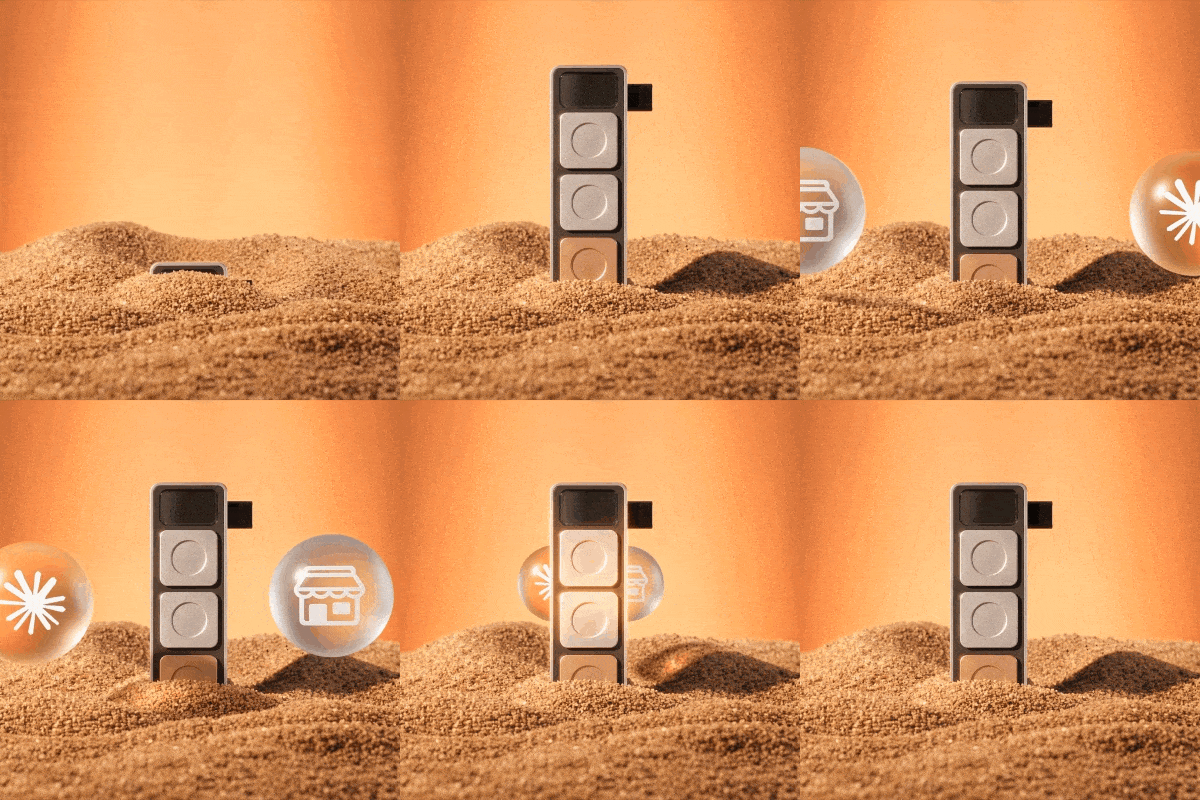
Dune Keypad is a context-aware physical macropad for Mac that sits beside your primary keyboard and dynamically reconfigures its mechanical switches based on the active foreground application. Integrated natively with Claude, VS Code, and terminal workflows, Dune provides single-press hardware actions tailored to your immediate programming context without memorizing arcane key combinations.
"Keyboards haven't fundamentally changed since the IBM Model M in 1985. But software complexity has exploded. Dune Keypad gives developers a physical, context-sensitive companion that adapts to what they're doing right now." — Maxime Dubois, Hardware Lead
The Cognitive Burden of 200 Keyboard Shortcuts
Modern software engineers constantly switch between disparate environments:
- VS Code:
Cmd+Shift+P,Cmd+K Cmd+S,Ctrl+Shift+B - Terminal & Git:
git status,git commit --amend,docker compose restart - Zoom / Google Meet: Mute audio, toggle camera, share desktop screen
- AI Coding Prompts: Opening Claude artifacts, triggering code generation, reviewing diffs
Remembering dozens of non-intuitive multi-key chords creates continuous cognitive friction.
Context-Aware Window Sensing in macOS
Dune Keypad connects over USB-C and pairs with a lightweight, open-source macOS background daemon:
- Window State Polling: Subscribes to the macOS Accessibility API to detect active window focus changes in less than 8 milliseconds with zero perceptible CPU overhead.
- Dynamic Layer Mapping: If VS Code is focused, Key 1 stages Git diffs, Key 2 triggers inline AI generation, and Key 3 runs the test suite. When Chrome is focused, the same keys instantly map to reload cache, inspect element, and copy URL.
- Community Extensions: Developers can write custom JavaScript or shell extensions to bind keys to Raycast scripts, GitHub CLI commands, or custom API webhooks.
Firmware Architecture & Mechanical Construction
Crafted from solid anodized aluminum and fitted with hot-swappable mechanical switches:
- RP2040 Dual-Core Microcontroller: Runs custom QMK-based firmware with sub-millisecond key debounce latency.
- OLED Context Indicators: Micro-displays above each key render crisp icons and dynamic labels indicating the active function.
- Local Security Posture: The companion daemon runs 100% offline without telemetry or cloud keylogging risks.
Workflow Velocity & Usability Benchmarks
In field testing with 50 full-time software engineers over a 30-day period:
| Measurement Metric | Standard Keyboard Chords | Dune Context Keypad | Impact |
|---|---|---|---|
| Git Staging & Commit Cycle | 6.2 seconds | 1.1 seconds | 82% faster routine actions |
| Meeting Mute / Unmute Speed | 3.5 seconds (finding window) | 0.2 seconds (dedicated key) | Zero hot-mic accidents |
| Key Mispress / Error Rate | 11.4% on 4-key combos | 0.0% (Dedicated switch) | Eliminates typo mistakes |
| Context Switching Fatigue | Significant mental overhead | Muscle memory retention | High user satisfaction |
Conclusion & The Future of Tactile AI
As autonomous AI agents become core to the development loop, tactile physical interfaces provide a grounding point for human oversight. With instantaneous window awareness and open community extensions, Dune Keypad re-imagines how developers interact with their machines.
Learn more about Dune Keypad and explore context-aware hardware workflows today.